
Behind the Passion
A World Cup in which we all lost. Report on the human rights situation of migrant workers in Qatar. Ever since Qatar won the rights to host the 2022 World Cup, there has been intense debate about the treatment of foreign workers and the human cost of staging […]
By Guillermo Whpei · President of Fundación para la Democracia · Articles by Guillermo Whpei


A World Cup in which we all lost
Report on the human rights situation of migrant workers in Qatar.
Ever since Qatar won the rights to host the 2022 World Cup, there has been intense debate about the treatment of foreign workers and the human cost of staging an event of this kind. There are various estimates of how many workers have died on World Cup construction sites in Qatar, but the real figure is difficult to determine. Nevertheless, according to a recent investigation carried out by Fundación para la Democracia, nearly 16,000 migrant workers may have died in Qatar between 2010 and 2022. 14,716, to be exact, according to official statistics from the government of Qatar. This means that, on average, some 23 lives have been lost every week since 2010.
A team from Fundación para la Democracia traveled to Nepal in November 2022 to conduct fieldwork, carrying out in-depth interviews with some of the relatives of those who died in Qatar and with workers who did manage to return, who are one of the few reliable sources of information we have left. This investigation has been under way since 2016, after local human rights organizations began to denounce the systematic abuses to which workers relocated to Qatar were being subjected.
“Already at that time we said it was necessary to keep our eyes on what was happening in Qatar because workers' lives depended on it. Despite the efforts made over the years by various human rights organizations, Qatar continued the systematic violation of migrant workers' human rights for more than a decade, which is what the construction of the opulent structures to host the World Cup took, an event they were not ready to receive with the existing infrastructure,” denounces Guillermo Whpei, president of Fundación para la Democracia.
What number of deaths are we talking about?
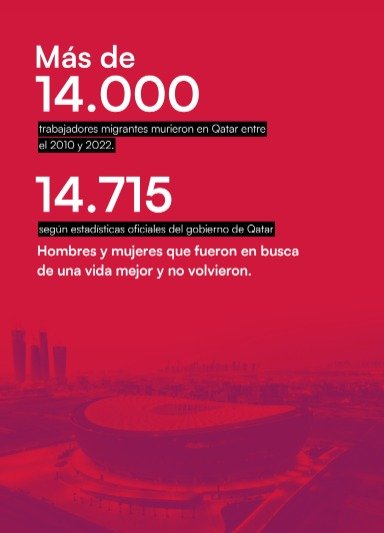
Until November 20, 2022, when the ball started rolling at the World Cup, Qatar kept an arbitrary record of 37 deaths from natural causes during the construction of stadiums, hotels, convention centers, roads, railways, tunnels, bridges, etc. Before the month was over, it was already acknowledging 500 deaths. A figure that is still very far from reflecting reality.
In Nepal alone, 2,400 deaths were recorded during that period, and according to our records, the total figure in Qatar could be close to 16,000 deaths. Its public records list 14,715. Although it is practically impossible to obtain real data given the secrecy with which the Qatari government has handled this issue, Fundación para la Democracia bases its study on official statistics from the Qatari authorities themselves, and refers to the number of foreigners who died in the country between 2010 and 2022. The Foundation itself cannot state that all of these people died on stadium construction sites, or even in the explicit context of the 2022 World Cup. The figures simply refer to non-Qataris of various nationalities and in various occupations who have died in Qatar over the last decade. This information can be found on the website of the Government of Qatar
Nor do these statistics include migrant workers who die after returning to their countries of origin. In Nepal, over the last 10 years, for example, the authorities recorded a significant increase in the number of fatal cases of kidney failure among men aged 20 to 50, many of whom had just returned from working in the Middle East. Hard work in the Gulf's climatic conditions, combined with the small quantity and poor quality of drinking water, as reported by those affected, would explain this, according to health experts in Nepal.
“A government report establishes that 7,467 Nepali workers died in their countries of employment between 2008 and 2019. The database is limited to information from relatives of those deceased migrants who have claimed compensation and does not cover all deaths abroad, particularly those of undocumented workers,” reads a Kathmandu Post article from March 2021.
The same article says: “Every day, around 1,500 workers fly from Tribhuvan International Airport to different countries and 3 workers return in coffins.” This situation was what first caught the Foundation's attention: the figure for the coffins being received at the airport every day.
From where? Mainly from Qatar.
Information from India, Bangladesh, Nepal and Sri Lanka revealed that there were 5,927 deaths of migrant workers during the 2011-2020 period. For its part, the Pakistani embassy in Qatar reported another 824 deaths of Pakistani workers between 2010 and 2020.
We know that the number of deaths is significantly higher, given that the statistics do not include deaths from countries that send large numbers of workers to Qatar, such as the Philippines and Kenya, and deaths that occurred at the end of 2020 are not counted.
Both FIFA and the Qatar World Cup organizing committee insist that only three people have died as a direct result of their work on World Cup construction sites. FIFA and Qatar's official definition of “work-related deaths” refers to deaths on the construction sites of the seven new stadiums, as well as the training facilities that Qatar has built over the last decade. The three include two Nepali men at Al Janoub Stadium in Al Wakrah and a British man at Khalifa International Stadium in Al Rayyan.
The official acknowledgment of three deaths therefore rules out deaths that may have occurred at other construction sites that probably would not have existed without the World Cup. Nor does it take into account thousands of documented cases of migrant workers who die in their accommodation outside working hours, for which no adequate explanations have been provided. According to an investigation by The Guardian and Amnesty International, the latter with figures provided by the government of Bangladesh, Qatari doctors attribute around 70% of deaths to “natural deaths caused by acute cardiorespiratory failure.”
The figures referring to deaths in connection with the 2022 World Cup vary depending on the definition, including the origin of the migrant workers, where and when they died, and whether or not their deaths can be described as work-related. However, given the inconsistencies and shortcomings in Qatar's own official data, it is impossible to reach a concrete conclusion, which in turn raises the question of why exactly the Qatari authorities cannot provide reliable information.
At Fundación para la Democracia we maintain that the World Cup is only the kickoff. Because there are thousands of devastated families waiting for an answer, for compensation, but above all for justice for the deaths of their loved ones. Because there are thousands of workers with lifelong injuries that make it impossible for them to continue supporting their families, sinking them even further into dependency and the most extreme poverty. Because there are thousands of workers who are still in debt and have no alternative but to leave their countries again to try to pay off their debts.
We are convinced that what happened in Qatar must never happen again. We want FIFA to demand a human rights standard from the host country. Hosting the World Cup is a privilege, and whoever does so must guarantee respect for human rights.
Qatar must be the turning point.
Never again Qatar.
Never again corruption.
Never again football associated with shame and death.
President of Fundación para la Democracia
This article was translated automatically from Spanish. Read the original


